Every piece of writing has a section that guides the piece in a certain direction; and grant proposals are no different.
No section is more essential than the statement of need. This is the foundation of your grant proposal, where you explain what problem your organization solves for your community.
Yet, this is the section where many nonprofits drop the ball. Many grant proposals fail because the problem is not clearly defined in the statement of need.
In this blog post, we’ll find out what a statement of need is, why funders focus so much on this section, and how to make a statement of need as effective as possible.
What is a Statement of Need?
In a grant proposal, the statement of need is the section where a nonprofit clearly defines the problem that they are solving within their community.
The more detailed you are when writing about your problem, the better. By the end of this section, the funder should understand:
- What your problem is
- Who is affected by your problem
- How the problem affects the community, and
- Why action is necessary.
Even if your problem is something as well-known as low literacy rates, you must clearly define how this problem is affecting your community using a combination of data, community insights, and real-world perspective.
Why Funders Care About The Statement of Need
Funders focus on this section because it showcases how well an organization can clearly define the problem that their community faces, as well as how to tackle this problem with the appropriate funding.
There are thousands of nonprofits applying for funding. How is your community in particular affected by a certain problem? How well does your organization understand the problem that’s affecting your community?
You need to be able to explain to funders the specific problem affecting your community, the long-term effects the problem will have if it continues in your community, and what goals and solutions your organization can create to address the problem.
By the end of your statement, funders should feel that their funding will solve a meaningful issue. And as they’re reading the rest of your proposal, they’ll come back to the statement to see how your goals and evaluation plan align with the need.
Think of your statement of need as a spider web. Every other section of your grant proposal should connect back to it.
5 Essential Elements of a Strong Statement of Need
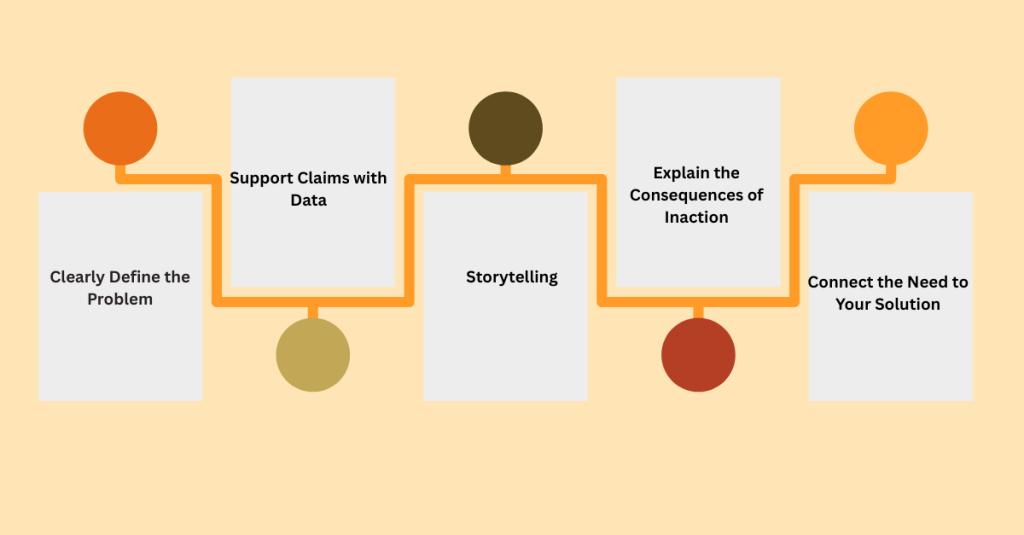
Because your statement of need is the nucleus of the proposal, you want to be as thorough as possible when writing it.
To do that, make sure that five of these elements are included:
Clearly Define the Problem
This may be obvious, but so many organizations miss the mark when it comes to stating what problem their organization is trying to solve.
Common Mistake: Nonprofits spend too much time writing about themselves. Instead of describing the issue that their community faces, they’ll spend time explaining why their organization deserves the grant.
When defining the problem that your community faces, don’t even mention your organization. Write about the following information:
- The issue that affects your community
- Who is affected
- Where and how the problem occurs
- How relevant the problem is to the community.
The more detailed you are in describing the problem, the more you demonstrate how much you understand the issues addressing your community.
Support Claims with Data
After you’ve defined the problem, you want to verify whatever claims you make with data.
What type of data do you want to include? It depends.
While some grant applications require you to submit specific types of data like statistics, personal testimonies and research studies can also be used to make your case.
Common Mistake: Nonprofits share too much information in their statement of need.
You don’t want to bore funders with a ton of data. Every statistic related to your problem does not need to be included in your statement.
What you want to do is gather the most significant data and organize it to strengthen your claims.
You also want to make sure that you include the most relevant data. You don’t want to make a case for your organization using outdated statistics. It may seem that you are not up-to-date on the issue your community is facing, and as a result your solutions could be ineffective.
Include a Human Element (Storytelling)

Including a human element in your grant proposal is sharing stories from the residents in the community.
Yes, statistical data brings credibility to your claims. But there’s a different credibility that stories bring to your proposal.It gives a real-world perspective to the issues the community is facing.
Common Mistake: Nonprofits will provide many unsupported claims in their statement. To avoid this, share testimonies from members of the community.
Hearing from voices within the community provides a different type of transparency.
Just like with the statistical data, you want to include stories and community observations that are relevant to your claims.
Explain the Consequences of Inaction
Next, you want to emphasize the long-term consequences of what will happen if the problem continues.
This is where you want to stress a sense of urgency in addressing the problem. You want to convey to the funders:
- What will happen if the problem continues
- Who are the people that will be affected
- What long-term effects could occur if the problem isn’t addressed.
Connect the Need to Your Proposed Solution
Last but not least, you want to wrap your statement up by connecting the need to your proposed solution.
This is where alignment is key. You need to explain how your organization is fit to address the problem.
You can do this by connecting your solution directly to the need. Whatever project or solution you propose, you must show how it aligns with the underlying issue of the problem, not just its issues.
Next, you can write about your organization expertise. Use your staff expertise, existing partnerships, and prior program outcomes to explain why your organization is positioned to carry out the solution.
Writing specific, measurable outcomes can also strengthen your statement. Instead of offering generic results, be specific about the number of people that this project will help.
Final Thoughts
A strong statement of need sets the foundation for the entire grant proposal.
Every other section of your proposal – the project description, the evaluation plan, and the budget – will connect back to the statement of need. That’s why you want to make sure that it is thoroughly defined.
Remember to strengthen your statement by clearly defining the problem, supporting your claims with data, including a bit of storytelling, explaining the consequences of inaction, and connecting the need to your solution.
Request a Quote
If your organization needs a grant proposal writer, click on the button below to request a quote.
 Valeria Publications
Leave a comment